Press Release
From Less to Zero – Intelligent System Solutions by ZF
- Less emissions – Ready for decarbonization with ZF cPOWER
- Zero emissions – New modular e-platform ZF eTRAC covers power range from 20-230 kW for construction machinery
- Future-proof transmission control unit fulfills upcoming cyber security standards
The construction industry is about to see massive changes, driven by volatile markets, economic uncertainties, and governmental regulations, demanding high flexibility and fast development cycles. At Bauma Munich, ZF proves that as a specialist in driveline technology and intelligent system solutions, the Group is the ideal partner to meet these demands.
Less emissions – Ready for decarbonization with ZF cPOWER
In addition to future-oriented e-mobility solutions, a transition towards low carbon fuels can currently be observed on the market, when it comes to decarbonization of construction machinery. Depending on the vehicle´s size and energy demand, different energy sources are possible. Whilst batteries are a suitable source for electric compact and medium vehicles, alternative fuels are a promising power source for medium and large size vehicles to reduce their CO2 footprint.
Efficiency will play an even more important role in the future. This is due on the one hand to steadily rising energy costs, on the other hand to a lower energy density of alternative fuels which in turn, require higher storage volumes.
Despite all the different power sources entering the market recently – be it hydrogen, eFuels or, for example, bio-diesel – conventional drives with powershift and power split transmissions will remain to be the backbone of the vehicle´s system architecture.
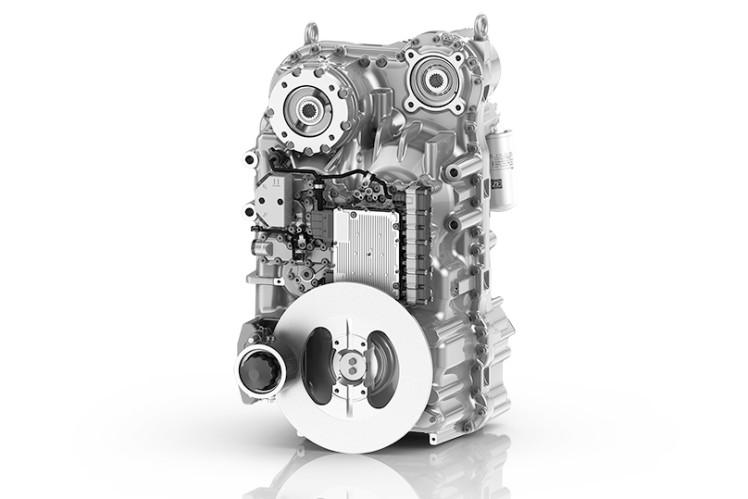
No matter the power source, conventional diesel, alternative fuels, or electrification: ZF is more than up to these challenges. With the well-established ERGOPOWER powershift transmission as well as highly efficient cPOWER CVT technology ZF can provide the right driveline technology, independent from the power source (fig. 1).
Zero emissions – New modular e-platform ZF eTRAC covers power range from 20-230 kW for construction machinery
The eTRAC electric drive system satisfies all the expectations for performance and productivity found in traditional drivelines and combines them with the extensive benefits and opportunities that electric systems have to offer. Thanks to its modular design this new range of electric central drives can easily be adapted for various vehicle applications. With its latest development - eTRAC eCD110-230 – ZF now covers the power range from 20-230 kW for construction machinery (fig. 2).
- Zero emissions without compromising on performance
- Low noise level
- Efficient electrical components
- Robust and reliable mechanical driveline
- Compact installation space
E-mobility solutions for compact vehicles such as loaders, site dumpers or telehandlers are the first to enter the construction equipment market, especially in urban or emission-regulated areas. The eTRAC driveline system with its range of 48/96/650-volt e-motors developed by ZF provides the necessary emission-free drive. Additionally, the Group also acts as system supplier (fig. 3). It not only supplies the electric drive, but also offers a combination of front and rear axles, inverters and an eDCU (Electric Drive Control Unit). This best-in-class solution achieves the same output as conventional drivetrains, without compromising on performance factors such as traction and end speed.
A newly launched system for mobile excavators consists of a 2-speed powershift transmission, electric motor, and inverter (fig. 4). It can be scaled up to peak torque 850 Nm and continuous power of 80 kW. Three power classes of the electric central drive system eCD50, eCD70 and eCD90 are available to cover different vehicle sizes in the targeted applications. The electric central drives can easily be adapted for various vehicle applications like backhoe loaders, telehandlers, or forestry equipment. To complete the customers´ demand, not only in regards of traction drive, ZF also offers the so called ePTO, e.g., to run the working hydraulic. The electronic drive control unit eDCU completes the system regarding traction drive.
For one of the main operational functions of an excavator on construction sites – the rotation of the upper carriage – ZF has developed the fully electric swing drive eDR. In addition to the actual driving operation, it is now also possible to operate the rotation movement electrically, which ensures even more savings regarding energy and CO2 emissions.
To complete the range of electric drives for larger construction vehicles, ZF is offering the eTRAC eCD110-230 series for mid-sized wheel loaders, consisting of an electro-mechanical powershift transmission and newly developed ZF e-motors for traction and ePTO. An electric drive control unit for overall system performance and power management completes the system (fig. 5). With a 650 V operating voltage, the system can be scaled up to 120 kW continuous power; the ePTO ranges from 30 to 70 kW continuous power. Thanks to its modular design, the system can be integrated in various other vehicle applications as well and can be driven independently from the power source. The company´s solutions fit in both battery-electric vehicles and fuel-cell battery electric vehicles, which will also play a big role in the future of construction machineries.
Future-proof transmission control unit fulfills upcoming cybersecurity standards
In today’s interconnected world, safeguarding sensitive data and systems from cyber threats is essential. Cybersecurity is especially critical in vehicles to ensure the safety and integrity of their systems. ZF addresses this challenge with its Drive Control Unit EC5, which is “cyber security ready” and adheres to upcoming cybersecurity standards. This includes compliance with both the Cyber Resilience Act and the Machine Regulation which will become effective within the EU in 2027 (fig. 6).
- EC5 ensures highest levels of safety and integrity for the entire vehicle system
- EC5 is based on technology transferred from the commercial vehicle application
- Software CAN interface to OEM remains unchanged compared to previous models
- Hardware will be plug and play, meaning same connectors, form and fit