Press Release
ZF Advances Practical, Technology-Open Pathways to Help Reduce Commercial Vehicle Emissions
- Technology-open approach can support OEMs and fleets in reducing emissions across selected applications and regions
- Hybrid and electric driveline technologies support a gradual and economically viable transition
- Driveline, braking, air management and software contribute to higher vehicle efficiency
- Scalable solutions help customers balance sustainability, operational performance and total cost of ownership
Friedrichshafen/Hanover, Germany. Ahead of IAA Transportation 2026, ZF demonstrates how commercial vehicles can support emissions reduction through a technology-open approach. As different applications, duty cycles and markets demand different solutions, ZF combines hybrid technologies, electric driveline systems, efficiency-enhancing vehicle technologies and intelligent software into a comprehensive portfolio for decarbonization. This can support OEMs and fleets in pursuing emissions reductions at a pace aligned with their applications, infrastructure and regional requirements, while balancing adaptable operational performance and total cost of ownership.
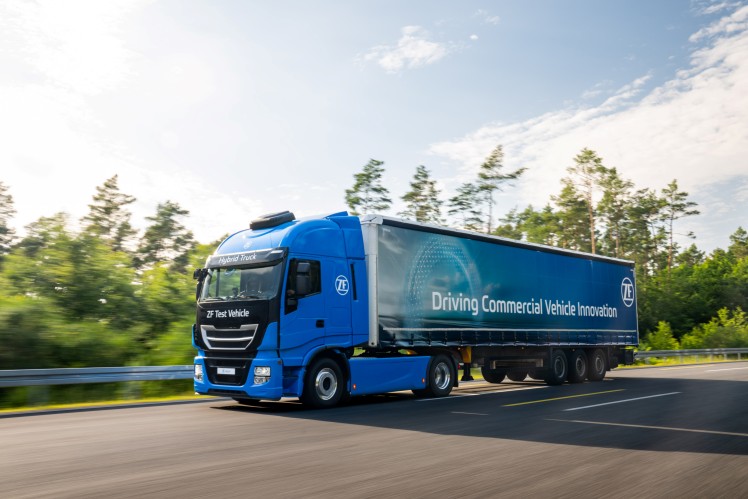
At the core of ZF’s strategy is a technology-open driveline portfolio based on scalable and modular platforms. It covers conventional, hybrid and electric driveline configurations for commercial vehicle applications across global markets. Building upon proven systems and components across different architectures, ZF provides customers with select solutions suited to their specific applications, infrastructure and regional requirements. System integration and intelligent software complement this portfolio by unlocking additional efficiency potential.
“There is no single pathway to lower emissions in commercial vehicles,” says Winfried Gründler, Head of Business Unit Driveline Solutions at ZF. “Customers need solutions that can support emissions reductions today and still make economic sense. Our technology-open portfolio supports OEMs and fleets in maintaining adaptable operational performance.”
Hybrid and electric driveline technologies support different customer needs
ZF’s modular driveline approach lets customers select the level of electrification that best fits operational requirements. Hybrid technologies such as the TraXon 2 Hybrid transmission allow for a gradual shift from conventional to electrified powertrains, particularly in applications where fully electric operation is not yet economically or infrastructurally feasible. Designed for heavy-duty applications, the system combines hybrid and electric driving modes, supports energy recuperation and enables electric driving in low-emission zones. Built on the trusted TraXon transmission platform and leveraging components from ZF’s electric driveline portfolio, TraXon 2 Hybrid combines the advantages of electrification with the reliability and flexibility of a conventional powertrain. This can help operators reduce fuel consumption and associated emissions, depending on the operating profile and system configuration without compromising range or operations.
For applications where fully electric operation is the suitable pathway to decarbonization, ZF continues to advance its electric driveline portfolio. Electric central drive systems from the CeTrax 2 family provide a scalable electrification solution for existing ICE vehicle architecture. Upcoming enhancements, including higher power levels, broader application coverage and Power Take-Off (PTO) availability, will enable the platform to support an even wider range of commercial vehicle applications. The AxTrax 2 electric axle family supports dedicated electric vehicle platforms and is further evolving with higher output torque levels, allowing for increased gross combination weights and broadening application coverage. Its recent start of production in China underlines the growing global demand for electric axle solutions in commercial transportation.
ZF also extends its approach to adaptable transportation beyond the driveline. Electrified trailer concepts and air management systems offer additional potential to improve energy efficiency and support emissions-reduction objectives. Trailer electrification builds on ZF’s expertise in e-axles, braking systems and vehicle integration and is being demonstrated in development and pilot projects. At the same time, ZF’s e-comp Scroll air compressor improves overall vehicle efficiency. Its oil-free design improves compressed air quality and helps reduce maintenance requirements, while low noise levels support applications such as urban bus operation.
System integration and software increase overall vehicle efficiency
“Hybrid and electric driveline technologies are key building blocks for adaptable transportation,” says Dr. Johannes Heseding, Manager Innovation Electrification & Efficiency. “Further significant efficiency gains can be unlocked through the intelligent interaction of ZF systems across the vehicle, especially through the synergies between driveline and braking systems.”
Thus, integrated control functions coordinate driveline, braking and energy management systems to optimize energy usage and support further reductions in emissions and operating costs. These benefits cannot be achieved by individual components alone.
As regulatory requirements and markets expectations to evolve towards lower-emission and more efficient transportation, OEMs and fleets need to adapt vehicles to regional requirements and regulatory timelines while maintaining flexibility for upcoming developments. With its scalable technologies, ZF offers OEMs and fleets solutions designed to support compliance with current and upcoming regulations, including emissions standards such as Euro 7, while showcasing feasible pathways for the future.
ZF at IAA Transportation 2026
ZF will present its latest technologies for commercial vehicle decarbonization at this year's IAA Transportation in Hanover, Germany (Hall 21, Booth B42), including enhancements for hybrid and electric driveline solutions.